Visit EnablingLearning.com →

Meet Verónica, Your Virtual Tutor!

Meet Verónica, Your AI-Powered Virtual Tutor! - EnablingLearning.com

After over a year of rigorous beta testing, we are thrilled to announce that Verónica, our AI-powered virtual tutor, is now available to all our users! This revolutionary tool is integrated into all our online courses and professional development workshops, offering personalized support and guidance to all our users.

What is Verónica?

Verónica is an AI-powered virtual tutor designed to enhance bilingual and ESL education. Built on a large language model, Verónica has been meticulously trained using a wealth of professional knowledge from Enabling Learning’s resources, including books, workshops, and training materials. This foundation allows Verónica to provide accurate, context-aware responses that reflect best teaching practices and specialized language use in bilingual education.

The Science Behind Verónica

The development of Verónica leverages advanced AI techniques such as prompt engineering and embeddings. These methods ensure that Verónica can understand and generate human-like responses, making interactions with her both meaningful and productive.

Prompt Engineering:  This technique involves crafting specific prompts that guide Verónica in generating useful and relevant responses. By fine-tuning these prompts, we ensure that Verónica’s advice is tailored to the unique needs of bilingual and ESL educators.

Embeddings: Embeddings are representations of words or phrases in a continuous vector space. This enables Verónica to grasp the context and subtle complexities of language, offering more precise and appropriate support. By using embeddings, Verónica can offer insights and feedback that are linguistically, academically, and culturally appropriate for bilingual education.

How We Trained Verónica

Training Verónica was a comprehensive process that involved using extensive datasets derived from our proprietary materials. These include:

  • Books and Guides: Resources such as “Conociendo el BTLPT y cómo prepararte para tener éxito” and “Navigating the Bilingual Education Supplemental” provided foundational knowledge.
  • Workshops: Interactive workshops that we have conducted over the years helped in training Verónica to understand real-world classroom scenarios and teacher-student interactions.
  • Professional Development Materials: Training resources used in our professional development programs were crucial in shaping Verónica’s ability to support teachers in their ongoing professional growth.

How You Can Interact with Verónica

Verónica is now an integral part of all our online courses and professional development workshops. Here’s how you can benefit from her expertise:

  • Real-Time Support: Verónica offers immediate, on-demand assistance, helping you navigate complex teaching scenarios and providing insights based on best practices.
  • Tailored Feedback: Whether you are preparing for certification exams or looking for strategies to support your bilingual students, Verónica offers personalized feedback and actionable strategies.
  • Innovative Practice Scenarios: Verónica uses advanced AI to create practice scenarios that are relevant to your teaching context, helping you to better prepare for real-life classroom challenges.

We are excited to bring Verónica to our community and look forward to seeing how she enhances your teaching and professional development journey. For more detailed information on the development and capabilities of Verónica, you can read our in-depth articles here.

Leave a Comment

Your email address will not be published. Required fields are marked *

More Posts

An educator and an adult learner smile as they review work together at a table, with a friendly AI tutor glowing on the laptop beside them.

How We Use AI, and Why Our Digital Credentials Require Evidence

When we talk about our work with educators, at conferences and with universities, two questions come up: how do we use AI, and what does our digital credential actually prove? We answered both in writing, in two new pages on our website. The first is a note from our founder, Luis J. Hernández, on how an educator came to build with AI and where we draw the line. The second explains why our digital credentials are issued only when a learner shows the skill, and why that matters for learners and the institutions that prepare them.

A single objectives card pinned on an elementary classroom wall, with a stack of cards for the rest of the week on the teacher's desk.

One Objective on the Wall. Five Levels in the Room.

Principals want the ELPS posted, but one classroom holds students at five proficiency levels. How do you post one objective for all of them? We answered with something teachers can print and use, the Objectives Card in the ELPS Online Helper: one content objective, one language objective, and a strip showing what meeting it looks like at each level. Here is what it does, what we added after seeing how teachers used it, including a week planner and cards for lessons taught in Spanish, and why it matters in a dual-language classroom.

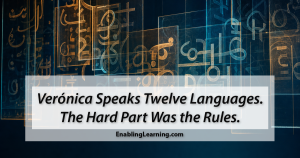
Layered translucent glass panes suspended in dark blue space, each etched with glowing abstract letterforms from a different writing system, overlapping and interlocking where the panes cross.

Verónica Speaks Twelve Languages. The Hard Part Was the Rules.

Verónica, the AI tutor inside our courses and apps, now responds in twelve languages. Arabic, Telugu, Tamil, and Korean joined because districts and teacher preparation faculty kept describing the families they serve. Adding the languages was never the hard part, since these models were multilingual from the start. The hard part was the rules: which characters even count as letters, whether the page or the person gets to decide, and when a tutor should hold the target language instead of following a student into English. Here is what broke, what we changed, and why it matters.

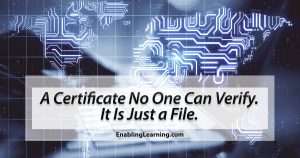
World map rendered as circuit board with the words A Certificate No One Can Verify. It Is Just a File.

A Certificate No One Can Verify. It Is Just a File.

Most professional certificates share one weakness: confirming they are real means contacting the issuer and waiting, so in practice it rarely happens. A PDF can be edited in a browser. A paper certificate proves only that someone owned a printer. This post makes the case for digital credentials for both learners and institutions, looks at what the 2026 hiring research actually shows, explains why course completion is the wrong trigger for issuing one, and describes transparently how our scored capstone gates work, why we chose the Proof of Knowledge platform, and what we would tell any institution starting from zero.

Scroll to Top
El acento escrito

¿Cómo colocarlo?

Si no sabes cómo colocar el acento escrito, te compartimos varios enlaces que te  pueden ayudar según sea el caso de tu dispositivo.

Windows – Keyboard shortcuts for international characters

Windows – How to Type Characters with Accents on Windows

Mac OS and iOS – Enter characters with accent marks on Mac

Android – Type in a different language