
AI-Generated Audio Summary
If you have ever studied Spanish writing seriously, you know the feeling: you understand the grammar, you can construct solid sentences, but the accent marks trip you up. Not because you do not know the rules, but because applying them consistently, under pressure, with confidence, is a different skill entirely.
This is especially true for anyone preparing for the BTLPT exam, where the written section requires you to produce extended responses in Spanish. Evaluators are looking at more than ideas; they are assessing your command of written conventions, including correct use of tildes. A misplaced or missing accent mark can shift meaning, change verb tense, or signal a gap in formal writing proficiency. Getting accent marks right is not a minor detail. It is part of what separates a passing score from a failing one.
That is why we built Acentúa la Frase.
What the Game Is
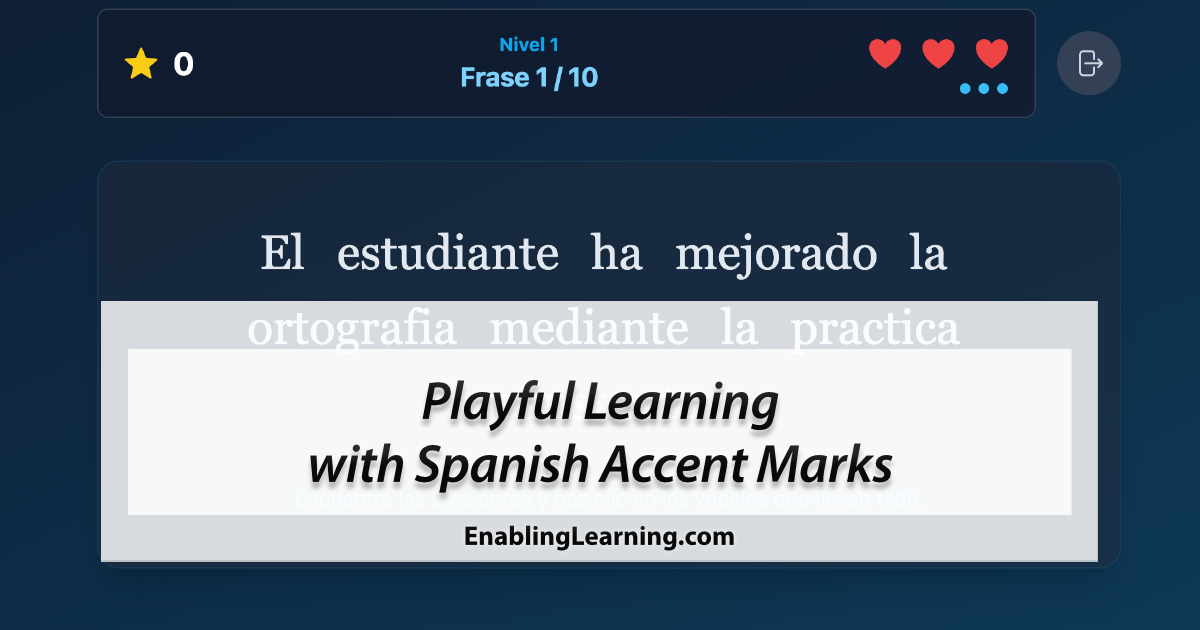
Acentúa la Frase is a free, browser-based interactive game designed to help you practice Spanish accent marks in context. It is not a quiz. It is not a worksheet. It is a structured challenge with real gameplay mechanics: lives, levels, scoring, hints, and progress saving.
The game contains 60 sentences organized across six levels of progressive difficulty. Each sentence is missing one or more accent marks. Your job is to:
- Read the sentence
- Click on the word that needs a tilde
- Select the correct vowel where the accent should go
You get three attempts per sentence. On your last attempt, the correct word flashes as a hint. If you run out of lives, the game ends. If you make it through all six levels, you win.
Every answer, whether correct or incorrect, comes with an explanation. This is the part that matters most. The game does not just tell you whether you were right; it tells you why. Each explanation is grounded in Spanish accentuation rules: diacritical tildes, hiatos, palabras agudas and esdrújulas, interrogative pronouns, and more. Every round is a mini grammar lesson.
Play It Now
The game is embedded right here. No login, no download. Just start playing.
Open in a new window (starts a separate game)
Want daily practice beyond these 60 sentences?
This game stays free. Ortografía Pro is a separate, paid app for adults who write in Spanish, such as bilingual teacher candidates preparing for the BTLPT or the TExES 165. It has 15 game modes, including this one, more than 1,000 verified exercises, a rules guide based on current norms from the Real Academia Española (RAE), and Verónica, an AI tutor who explains each mistake in Spanish. It is an individual subscription, and the app is in Spanish. Three months of access is $12.99.
See how Ortografía Pro worksPlans and prices (page in Spanish)
Why Accent Marks Matter for the BTLPT
The BTLPT (Bilingual Target Language Proficiency Test) is the certification exam Texas requires for bilingual education teachers. The written section evaluates your ability to write in Spanish at a professional level. This means proper grammar, varied sentence structure, appropriate vocabulary, and correct orthographic conventions, including accent marks.
Here is the challenge: many candidates know the rules in theory but struggle to apply them fluently when writing under timed conditions. The rules of accentuation in Spanish are systematic, covering classifications like agudas, graves, esdrújulas, and sobresdrújulas, as well as diacritical accents that distinguish between words like si and sí, or el and él. Understanding the system is the first step. Building automaticity is the second.
That second step is what the game is for. By practicing in a low-stakes, interactive environment, you train your eye and your instincts to recognize when a word needs a tilde and where it goes. Over time, this becomes second nature, which is exactly what you need when you are writing under exam conditions.
If you want a thorough review of the rules themselves, we have a dedicated post that walks through everything: La acentuación: su importancia y reglas. Read the rules first, then use the game to practice applying them.
What Makes It a Study Tool
- Contextual practice: You are reading full sentences, not isolated words. This mirrors how accent marks appear in real writing.
- Immediate feedback with explanations: Every answer teaches you something, whether you got it right or wrong.
- Progressive difficulty: The early levels build confidence. The later levels test your mastery.
- Low-pressure repetition: You can replay as many times as you want. The sentences shuffle each time, keeping the challenge fresh.
Part of a Larger Preparation System
Acentúa la Frase is one piece of what we are building at Enabling Learning for BTLPT preparation. Our platform includes AI-powered practice exams with automated evaluation, personalized study dashboards, and the BTLPT AI Language Lab for extended speaking and writing practice with real-time AI feedback.
The game is free because we believe foundational skills should be accessible to everyone. If you are a teacher candidate preparing for the BTLPT, a student working on your Spanish writing, or an educator looking for a quick, engaging resource to share with your class, this game is for you.
For your classroom, share the free game above. For daily individual practice, Ortografía Pro, a paid app, includes Acentúa la Frase as one of its 15 game modes. If you want the rules taught step by step first, see the course La acentuación y la práctica del acento escrito.
And if you want to go deeper, explore our full suite of BTLPT preparation resources or review the fundamentals with La acentuación: su importancia y reglas.
This post was written with the support of AI tools. All content reflects the voice and editorial judgment of Luis Hernandez, founder of Enabling Learning.




Leave a Comment