AI-Generated Audio
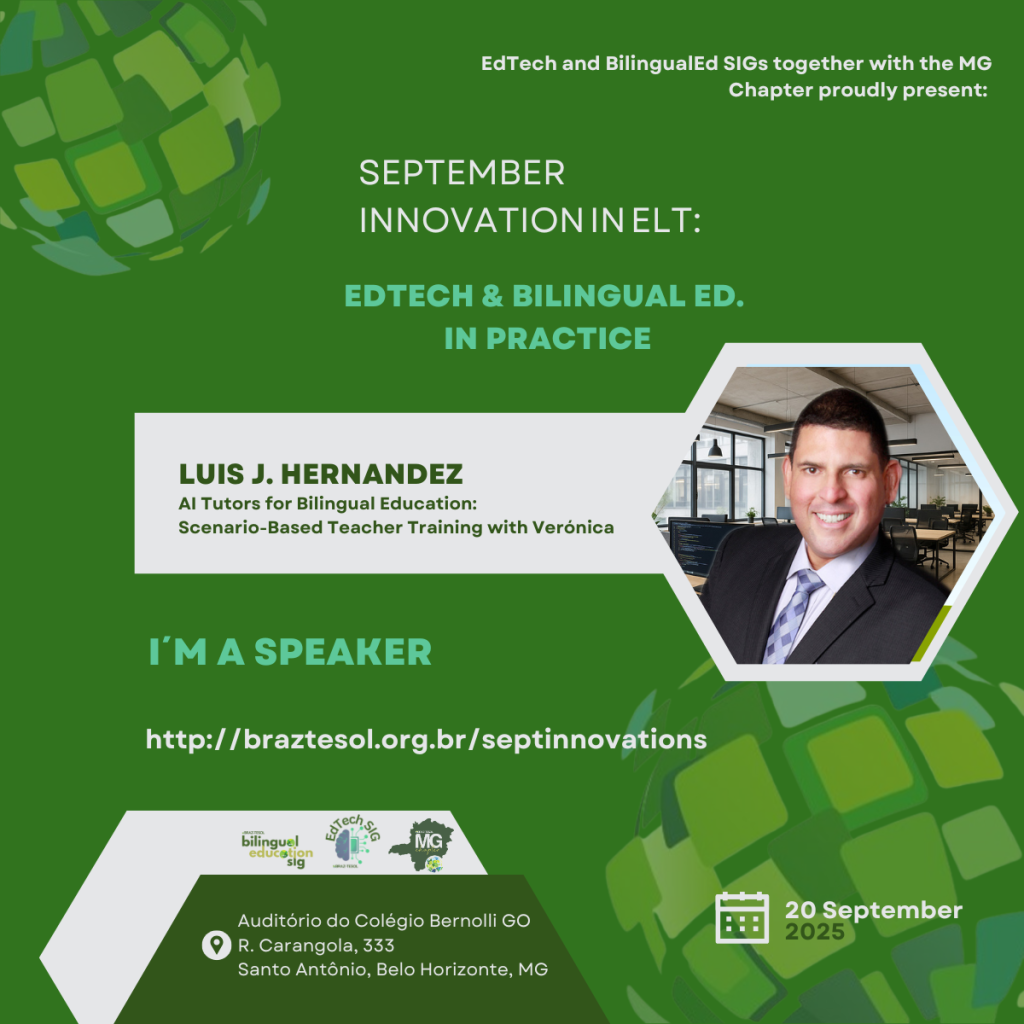
This week, I am honored to present at September Innovation in ELT (English Language Teaching): EdTech & Bilingual Education in Practice, an international conference co-organized by BRAZ-TESOL’s EdTech SIG, Bilingual Education SIG, and the Minas Gerais Chapter.
The event will be held in Belo Horizonte, Brazil, and will bring together educators, researchers, and practitioners to share perspectives on how educational technology and bilingual pedagogy are shaping the future of teaching.
About BRAZ-TESOL
For those unfamiliar, BRAZ-TESOL (Brazil Teachers of English to Speakers of Other Languages) is the largest English language teaching association in Brazil. Founded in 1986, it provides a platform for teacher development, knowledge exchange, and professional networking. Through conferences, workshops, and special interest groups (SIGs), BRAZ-TESOL connects local and international voices in the field of language education.
The EdTech SIG focuses on exploring the intersection of technology and language teaching — how digital tools, AI, and online platforms can be used to enhance teaching and learning. The Bilingual Education SIG brings attention to the realities of multilingual classrooms in Brazil and beyond, offering strategies for integrating language and content in ways that support all learners. Together, these SIGs have created a powerful space for dialogue at this year’s event.
My Session: AI Tutors for Bilingual Education
My presentation is titled “AI Tutors for Bilingual Education: Scenario-Based Teacher Training with Verónica.” In it, I will share our work at Enabling Learning, where we are experimenting with the use of artificial intelligence to prepare future bilingual teachers.
At the heart of this work is Verónica, our AI tutor, who supports pre-service and in-service teachers as they practice academic Spanish, rehearse classroom scenarios, and receive guided feedback. Verónica is not just a chatbot; she is trained with resources from teacher education, bilingual pedagogy, and certification exam frameworks. Her design allows teachers to interact with realistic challenges they might face in bilingual classrooms, while receiving personalized scaffolding and feedback.
Why Scenario-Based Learning?
Teacher preparation often struggles with a gap between theory and practice. We know that classroom management, language scaffolding, and cultural responsiveness are best learned in action, yet pre-service teachers don’t always have enough opportunities to safely practice these skills before entering the classroom.
Scenario-based learning, supported by AI, creates a bridge. Teachers can role-play authentic classroom moments: giving instructions in Spanish, supporting emergent bilingual students, or adapting lessons for different proficiency levels. With Verónica, these scenarios can adapt dynamically to the learner’s performance, offering fresh challenges each time. This creates an environment where teachers learn not only what to do, but how to think critically about their decisions.
Importantly, our system can also identify when learners need more support. If a teacher-in-training struggles in a particular area, the platform can flag that challenge and bring a human in the loop, either by notifying our subject-matter experts at Enabling Learning or by connecting with support teams at the institution where the learner is enrolled. This ensures that AI guidance is paired with timely human expertise. For a deeper look at how this process works, see my earlier post: How We’re Using AI to Redefine Teacher Preparation.
I look forward to sharing these ideas at BRAZ-TESOL’s September Innovation in ELT conference, and to learning from colleagues who are also exploring the intersections of language, culture, and technology. Events like this remind us that bilingual education is a global effort, and that by combining thoughtful pedagogy with new tools like AI, we can empower teachers to better serve multilingual learners everywhere.