AI-Generated Audio
Long before artificial intelligence entered classrooms, some of the most engaging digital learning experiences were surprisingly simple. They were text-driven, choice-based, and built around clear logic. You read a scenario, made a decision, and the story unfolded accordingly. What made these experiences compelling was not realism or graphics, but structure and consequence.
Those early systems relied on carefully designed paths. Each choice mattered. Behind the scenes, everything followed a predefined logic, often resembling a large flowchart, where decisions opened some possibilities and closed others. The experience felt dynamic, even though the structure was fixed.
Recently, I’ve found myself returning to that design approach, not out of nostalgia, but because it offers something essential for thinking about learning with AI today.
Structure First, AI Second
One of the biggest misconceptions about AI for learning is that it replaces instructional design. In reality, AI works best when it operates inside a well-defined framework.
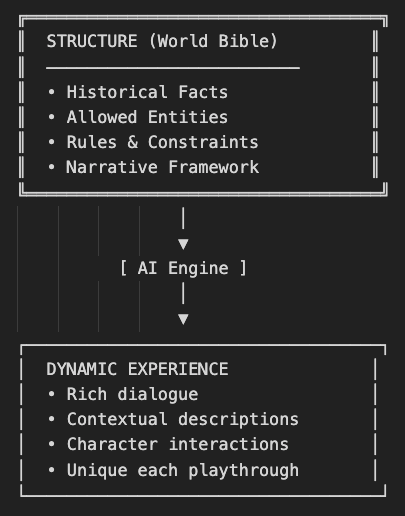
In my recent work, I’ve been exploring how strong narrative structure, what some designers might call a “story bible”, can serve as the foundation for dynamic, AI-supported learning experiences.
This approach comes from game design traditions, particularly from role-playing games (both tabletop and digital), open-world video games, and interactive fiction. Designers of games like The Elder Scrolls, Mass Effect, or tabletop systems like Dungeons & Dragons use story bibles to define the rules of their worlds: what exists, what’s historically true, what characters can and cannot do, and how the world responds to player choices. The “story bible” creates boundaries that make improvisation possible without breaking immersion or coherence.
In instructional design, this same principle applies. The structure defines the world: the setting, the constraints, the historical context, the rules of interaction. AI is then used to generate language, descriptions, and connections within those boundaries.
The result is an experience that feels alive and responsive, without becoming random or incoherent.
This approach uses guided narrative rather than open-ended conversation. At each point, learners see 3-4 specific choices rather than typing whatever they want. This design choice is intentional: it focuses cognitive load on decision-making and consequences rather than figuring out what to type or whether the AI will understand.
Think of it as the difference between a choose-your-own-adventure book (where you flip to specific pages) and a conversation with a knowledgeable person (where you can ask anything). Both can be effective learning tools. The adventure format works particularly well when you want learners to experience specific scenarios, make explicit choices, and see clear consequences, exactly what’s needed for language development and decision-making practice.
A Renaissance Example
To test these ideas, I’ve been building a text-based adventure set in Renaissance Italy. It’s part of a larger project I’m working on (more on that soon), but the game itself demonstrates how structure and AI can work together to create meaningful learning experiences.
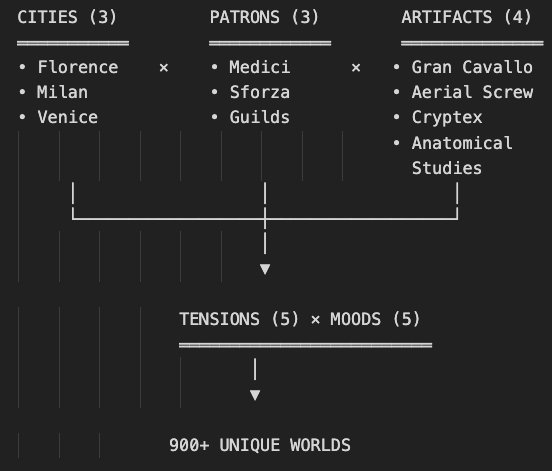
The game places players in the role of an apprentice navigating the world of Renaissance workshops, patrons, and discoveries. Each playthrough follows the same underlying story framework, but the narrative changes based on randomly selected variables:
- Cities and locations: Florence, Milan, or Venice, each with unique settings like the Medici workshops or the Venetian Arsenal
- Patrons: The Medici, the Sforza, or the Merchant Guilds
- Lost artifacts: From Leonardo’s Gran Cavallo mold to anatomical studies
- Social tensions: Rival sabotage, Church scrutiny, plague outbreaks
- Atmospheric moods: Opulent, shadowy, desperate, and more
Mathematically, there are over 900 unique combinations of these factors. Because AI generates the dialogue, descriptions, and character interactions in real-time within this framework, no two playthroughs feel the same.
Why This Matters for Learning
The real innovation isn’t the variety, it’s the constraint. By defining a “world bible” of historically accurate facts and allowed entities, the AI can generate rich, contextual storytelling without fabricating false information. The structure prevents hallucinations while enabling flexibility.
The puzzles in the game work the same way. Players encounter scientific challenges based on Renaissance-era principles (levers, gears, optics, engineering). The AI evaluates whether their solutions are scientifically sound, even if they approach the problem in unexpected ways. This means learning becomes exploratory rather than scripted.
Storytelling as a Learning Engine
Storytelling has always been a powerful vehicle for learning, especially when language development is involved. Stories provide context, purpose, and emotional connection, three elements that are essential for meaningful language use.
By grounding an experience in a historically inspired story world, we can connect language to real people, places, and ideas. The Renaissance framework allows learners to encounter technical vocabulary (engineering, anatomy, optics) in authentic contexts, not isolated word lists.
The interface is deliberately minimal: text-based with symbolic visuals and simple ASCII art. This reinforces the idea that meaning comes from interpretation, not spectacle. Players must read, think, and decide, not just click through animations.
Multilingual Possibilities
What makes this approach especially compelling for language learning is its multilingual potential.
Because the structure is language-independent, the same story world can be explored in different languages. Learners can experience the narrative in English, Spanish, or another language, noticing how meaning, tone, and expression shift while the core ideas remain intact.
This moves language learning beyond isolated vocabulary or grammar practice. Language becomes a tool for navigating a world, solving problems, and making sense of complex ideas, exactly how language functions outside the classroom.
In future iterations, I’m planning to explore code-switching and translanguaging within the same narrative, allowing bilingual learners to leverage both languages as resources rather than barriers.

Play, Choice, and Agency
One of the chapters in my upcoming book discusses aprendizaje lúdico (playful learning) and how games can create meaningful cognitive engagement. The key is not gamification for its own sake, but creating systems where learners must think, decide, and reflect on consequences.
Text-based adventures do this naturally. There are no flashy graphics to distract. The challenge is cognitive: understanding the situation, weighing options, and making decisions based on incomplete information. These are the same skills learners need for academic language and critical thinking.
By combining this with AI, we can create experiences that are:
- Replayable: Different variables each time
- Responsive: AI adapts language and descriptions to choices
- Grounded: Historical accuracy maintained through structured constraints
- Multilingual: Same framework, different languages
AI allows us to move beyond static learning materials without sacrificing coherence. When paired with thoughtful design, APIs and generative models can help create experiences that are flexible, replayable, and deeply contextual, while still respecting historical accuracy, instructional intent, and linguistic goals.
The key insight is not technological. It is architectural.
Strong learning experiences are built first on structure, then on interaction. AI simply gives us a new way to animate that structure with language.
IFE Conference 2026
On January 27, 2026, I’ll be co-presenting with Viviana Hall and Roberta Mesquita at the IFE Conference (Insights for the Future of Education) at Tecnológico de Monterrey in Mexico. Our panel, “Reimagining Multilingual Classrooms: AI, Active Learning, and Digital Storytelling for a More Inclusive Future,” will explore how structured AI systems like this can support multilingual learners while maintaining pedagogical integrity (read more here).
The Renaissance adventure is an example of the digital storytelling approach we’ll discuss: structured narratives that adapt to learners, honor linguistic diversity, and create opportunities for authentic language use. The same principles that make this text adventure work (world bibles, constraint-based AI, multilingual design) are scaling across our work with teacher preparation programs and professional development systems in the United States, Mexico, and Brazil.
At the conference, we’ll demonstrate how these ideas translate into comprehensive AI mentorship platforms designed for multilingual professional training, always keeping human expertise at the center while extending its reach through thoughtful technology.
If you’re attending IFE 2026, find us on January 27 at 5:15 PM (Mexico Central Time) in Edificio CIAP, Salón 306. For those following remotely, more information is available at ifeconference.tec.mx.
As conversations around AI for learning continue to evolve, I believe there is value in revisiting earlier design principles and reimagining them with today’s tools. Text-driven storytelling, choice-based navigation, and carefully designed constraints offer a powerful alternative to purely conversational systems.
Sometimes, moving learning forward means looking backward, not to replicate old technologies, but to rediscover the ideas that made them meaningful in the first place.