
Why We Use Digital Credentials
When you finish a course with us, you should be able to prove what you can do. Not with a file anyone could edit, and not by asking us to vouch for you. You should be able to hand someone a link and let them see for themselves, in a few seconds, that what you are claiming is true.
That is why we issue verified digital credentials. Most of our courses and several of our practice apps include one, at no extra cost and with nothing extra to sign up for.
Why a credential, and not just a certificate
A PDF certificate can be opened in a browser and edited. A paper certificate proves that someone owned a printer. To confirm either one, the person receiving it, a district HR office, a principal, a university, a hiring committee, has to contact us and wait for a reply.
Most of the time, checking costs more time than it is worth, so the certificate quietly goes uncounted. A verified digital credential removes that step. It belongs to the learner, anyone can check it, and it cannot be altered after we issue it.
What stands behind every credential
This is the part we care about most, and the part many credential programs skip. A credential is only worth what the assessment behind it required. A polished badge issued for clicking through five videos is worth nothing, whatever standard it follows.
Our credentials are not issued for finishing the lessons. They are issued when the learner shows the skill.
Tasks designed by educators
Speaking and writing prompts, classroom scenarios, and full-length practice exams, built by people who have prepared candidates for these tests.
Evaluated with AI, against human rubrics
In courses that measure speaking and writing, AI scores each response using rubrics written by experienced educators, and gives specific feedback on every attempt. The AI applies the criteria; people define them.
A clear bar for each skill
On the BTLPT preparation course, the learner must meet a separate bar in reading, listening, speaking, and writing. If one falls short, the credential is held, the learner sees exactly where and by how much, and keeps practicing.
No evidence, no credential.That is deliberately harder than the alternative. It is also the only version worth issuing.
What the learner receives
Learners see every credential they have earned, and where they stand on the ones still in progress, on their account credentials page.
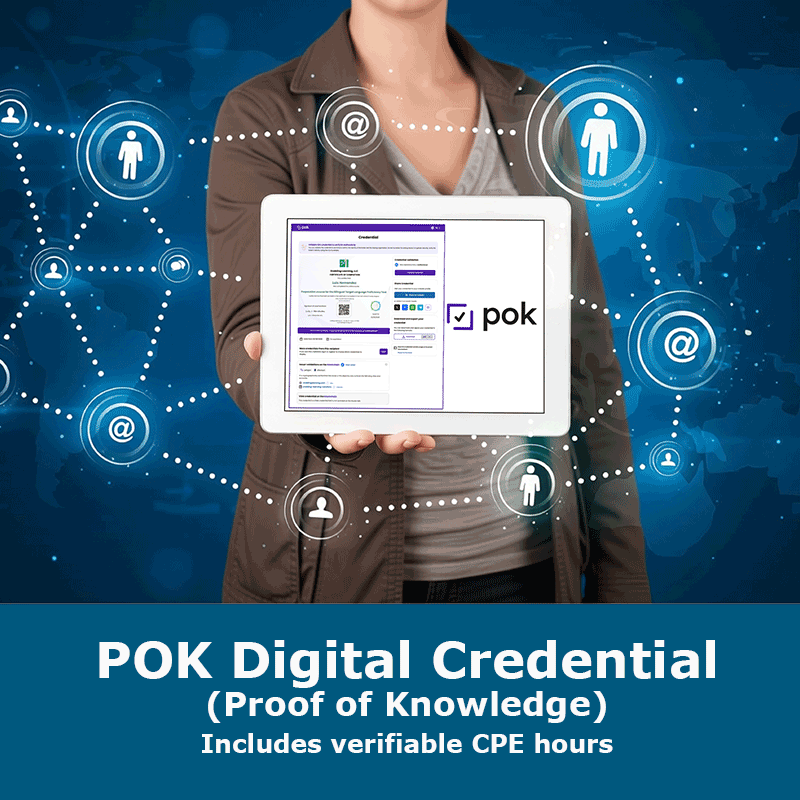
See one for yourself
Reading about verification is less convincing than doing it. Here is a sample credential issued to our founder’s own account. Open it the way a district would.
No login, no email to us, no waiting. That is the point.
Documenting professional development hours
For many teachers, this is the practical reason it matters. When you document professional development for a district, a certification renewal, or a personnel file, the questions are always the same: who provided the training, how many hours it was, and whether that can be confirmed. Your credential answers all three on one page, and anyone can confirm it in seconds.
A note on honesty, because this field attracts overstatement. The Texas Education Agency does not endorse any credentialing platform, and we will not suggest otherwise. What matters for CPE is the provider, the hours, and the documentation. A verifiable credential makes that documentation easy to check.
A credential that travels with the learner
Our credentials follow Open Badge 3.0, the international standard published by 1EdTech. That matters because learners do not stay in one place. A teacher candidate may start a program at one university, finish at another, teach in a different state, or move between countries. A credential built on an open standard goes with them, into a digital wallet, onto LinkedIn, and into any system that reads the standard, and it stays verifiable wherever they go.
For learners who trained in one country and work in another, that is not a small thing.
For universities, programs, and districts
If you run a program that sends candidates through our courses, verifiable credentials change three things right away.
There is no additional cost for credentials on any cohort, of any size.
Following learners after the course
The credential is one part of an equation. The other part is what happens after it is earned.
Institutions ask the same questions about their graduates: where they go, what roles they reach, how long it takes, and which programs make the difference. Much of that information already comes from surveys and follow-up. A verified credential that lives on a graduate’s professional profile opens another source of evidence.
POK, the platform behind our credentials, offers institutions an employability tracking system built on this idea. For graduates who share their credentials on LinkedIn, an institution can follow career paths, new jobs and promotions, and time to employment, and use that evidence for program evaluation, accreditation, and alumni relationships. It adds to what an institution already gathers; it does not replace it.
This is a service POK provides directly to institutions. If it fits your program, we are glad to make the introduction and show how our credentials connect to it. Get in touch.
Why we chose POK
Our credentials are issued through POK (Proof of Knowledge), which reports more than 1,100 institutions in 19 countries on its platform. We chose POK for four reasons. It is certified by 1EdTech for Open Badges 3.0 and follows the W3C Verifiable Credentials standard. Verification is free and asks nothing of the person checking. It works in Spanish and English, which matters for the learners we serve in Latin America. And it did not require any institution to replace systems it already had.
We work with POK as a partner, and we issue our credentials on their free plan. We say that plainly because you should know it when you weigh our opinion of them. We recommend them because the product does what it claims, and we would not put our learners’ records on a platform we did not trust.
Common questions
Does the credential cost extra?
No. When a course includes a credential, it is included for every learner at no additional charge.
Is this the same as state certification?
No. Our credential documents that you completed our preparation and met our performance bar. Certification is issued only by the state, after you pass the official exam.
Does someone need an account to verify my credential?
No. They open the link or scan the code. There is no login, no fee, and no form.
Does it expire?
No. The credential remains verifiable, and it stays in your account.
Can I put it on my resume and LinkedIn?
Yes, and we encourage it. LinkedIn sharing takes one click and places it under Licenses and Certifications, where recruiters look.
What if I do not reach the bar?
You keep your course access and you can keep working. Your account shows exactly which domains you have cleared and how far you are from the ones you have not. The credential is waiting when you get there.
Start earning one
Browse our courses Talk to us about a cohort
For the longer argument on why verifiable credentials matter, for individuals and for institutions, read A Certificate No One Can Verify. It Is Just a File.
Enabling Learning, LLC is a verified credential issuer on the POK platform. Credentials follow the Open Badge 3.0 international standard and can be verified by anyone holding the credential link.