Visit EnablingLearning.com
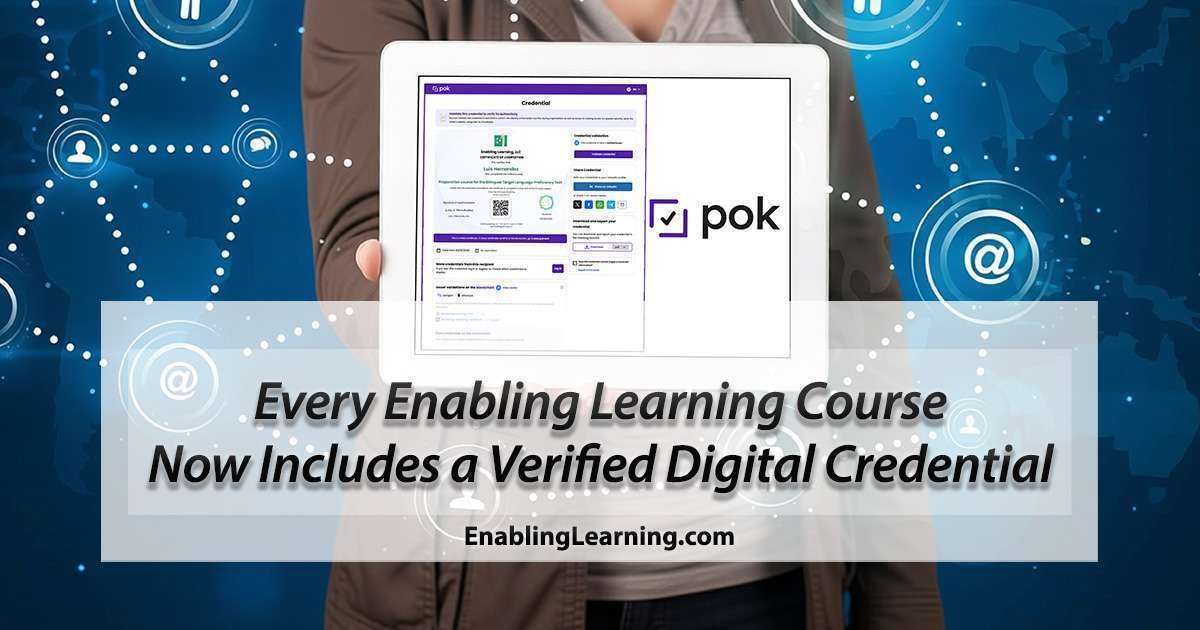
Enabling Learning digital credential displayed on a tablet, showing the POK verification page with QR code, LinkedIn sharing, and verified issuer status

AI-Generated Audio Summary

If you have ever had to prove your professional development hours to an employer, a school district, or a university, you know the problem. Paper certificates get lost. PDFs can be fabricated. And verifying that someone actually completed a course usually means phone calls, emails, and waiting.

Starting now, every student who completes an Enabling Learning course receives a verified digital credential that anyone can confirm in seconds.

What Changed

Enabling Learning is now a verified credential issuer on POK (Proof of Knowledge), the global platform for digital credentialing used by over 1,100 universities and organizations across 19 countries. POK has issued more than 1.5 million credentials worldwide.

This means your Enabling Learning credential is not just a local certificate. It follows the Open Badge 3.0 standard, the same international standard used by leading universities and employers around the world.

What You Get When You Complete a Course

  • A verified digital certificate with your name, course title, completion date, and skills developed
  • A unique QR code that links to a secure verification page
  • One-click LinkedIn sharing under “Licenses & Certifications”
  • A downloadable PDF for your records
  • A permanent credential accessible from any device, anytime

Why This Matters

Consider this: a school district receives two applications for a bilingual teaching position. Both candidates list professional development courses on their resume. One hands over a PDF certificate. The other says, “Scan this QR code.”

The QR code links to a verification page that confirms the credential is real, shows exactly what competencies were developed, and identifies Enabling Learning as a verified issuer. No phone calls. No follow-up emails. Instant confirmation.

That is the difference between a certificate and a verified credential.

How It Works

The process is simple and automatic:

  1. Complete your course: finish all modules, lessons, and required assessments
  2. Receive your credential: it is issued automatically upon course completion
  3. Share anywhere: add it to LinkedIn, send it to an employer, or download the PDF

You can view all your earned credentials on your My Digital Credentials page.

What Makes This Different from a Regular Certificate

Regular PDF CertificateVerified Digital Credential
Can be edited or fabricatedTamper-proof, issued by a verified institution
No way to confirm authenticityQR code links to a live verification page
Sits in a folder on your computerLives online, always accessible
Lists a course titleLists specific skills and competencies
Means nothing to someone who doesn’t know the issuerBacked by an international standard (Open Badge 3.0)

Get Started

Ready to earn your first verified digital credential? Browse our course catalog and enroll today.

If you have already completed a course and would like to receive your digital credential, contact us and we will issue it for you.


Enabling Learning, LLC is a verified credential issuer on the POK (Proof of Knowledge) platform. All credentials follow the Open Badge 3.0 international standard.
Leave a Comment

Your email address will not be published. Required fields are marked *

More Posts

Layered translucent glass panes suspended in dark blue space, each etched with glowing abstract letterforms from a different writing system, overlapping and interlocking where the panes cross.

Verónica Speaks Twelve Languages. The Hard Part Was the Rules.

Verónica, the AI tutor inside our courses and apps, now responds in twelve languages. Arabic, Telugu, Tamil, and Korean joined because districts and teacher preparation faculty kept describing the families they serve. Adding the languages was never the hard part, since these models were multilingual from the start. The hard part was the rules: which characters even count as letters, whether the page or the person gets to decide, and when a tutor should hold the target language instead of following a student into English. Here is what broke, what we changed, and why it matters.

World map rendered as circuit board with the words A Certificate No One Can Verify. It Is Just a File.

A Certificate No One Can Verify. It Is Just a File.

Most professional certificates share one weakness: confirming they are real means contacting the issuer and waiting, so in practice it rarely happens. A PDF can be edited in a browser. A paper certificate proves only that someone owned a printer. This post makes the case for digital credentials for both learners and institutions, looks at what the 2026 hiring research actually shows, explains why course completion is the wrong trigger for issuing one, and describes transparently how our scored capstone gates work, why we chose the Proof of Knowledge platform, and what we would tell any institution starting from zero.

Minimalist illustration of a white apple on a terracotta background with the title Claude for Teachers, Anthropic's Free Program for Educators

Claude for Teachers: Anthropic’s Free Program for Educators

On July 14, 2026, Anthropic announced Claude for Teachers, a program that gives verified K-12 educators in the United States a full year of free access to premium Claude capabilities. It includes a teaching skills library, lesson planning grounded in evidence-based curricula, class data analysis, and integrations with nine school tools. In this post, we break down what teachers actually get, the privacy commitments behind the program, and the honest caveats, including US-only eligibility. We also added a complete Claude for Teachers topic to our free course, Boosting Productivity with AI for Teachers.

Chalkboard reading Language Learning beside German, English, and Spanish dictionaries, for the Enabling Learning post on building AI language-learning tutors.

A Good LLM Doesn’t Make a Good Teacher

When people learn that our speaking apps run on advanced AI, they ask which model we use. It is the least interesting part of the story. Choosing a capable model is the easy part; any developer can connect to one. What decides whether a learner actually improves is whether the system understands how people learn to speak a second language. That knowledge does not come from the model. It comes from us, from years in bilingual classrooms, instructional design, and second language acquisition research. This post is about how we build AI tutors as educators, not just engineers.

©​ Enabling Learning Blog 2024
EnablingLearning.com​
About Us

Scroll to Top
El acento escrito

¿Cómo colocarlo?

Si no sabes cómo colocar el acento escrito, te compartimos varios enlaces que te  pueden ayudar según sea el caso de tu dispositivo.

WindowsKeyboard shortcuts for international characters

WindowsHow to Type Characters with Accents on Windows

Mac OS and iOSEnter characters with accent marks on Mac

AndroidType in a different language