This week, we’ve had the privilege of working with more than 120 students in Mexico as they prepare for the TOEFL and other academic English proficiency exams. We’re proud to build on what we’ve achieved with the BTLPT by extending personalized, AI-supported learning to hundreds of new students. Through a thoughtful blend of technology and instructional design, we’re creating experiences that respond to each learner’s progress while preserving the human connection that makes learning meaningful.
Our earlier work developing BTLPT preparation courses for bilingual teachers in the United States laid the foundation for this next stage. Those years of experience refining academic language practice (particularly in bilingual and multilingual settings) taught us how to combine pedagogical depth with technological precision. Now, we’re taking those lessons further, applying them to English proficiency training across Mexico and Latin America.
Building Reliable AI-Based Learning Systems
Much of the recent conversation about AI in education has focused on its limitations, issues of accuracy, shallow responses, or even “hallucinations.” While these concerns are valid, they also underscore the importance of thoughtful instructional design and responsible AI implementation. At Enabling Learning, we’ve been intentional about this from the beginning. Since we first started integrating AI into our courses and professional development programs, our goal has never been to replace teaching; it has been to enhance it through structure, precision, and adaptability.
Rather than relying solely on public tools like ChatGPT, we build our systems directly on top of OpenAI’s API models, combining them with specialized AI models for audio generation, image creation, and automated evaluation. We also employ retrieval-augmented generation (RAG) and carefully structured databases to ensure that every activity draws from verified, context-specific information. This approach allows us to design tasks that are not only accurate and multilingual but that also mirror the complexity and authenticity of real communication in multilingual classrooms.
Our virtual tutor, Verónica, has been central to this evolution. She now supports learners across our online courses and hybrid professional development workshops in collaboration with universities, teacher preparation programs, and school districts. T
hrough consistent, data-driven feedback, Verónica adapts to each learner’s goals and proficiency domains, offering targeted guidance that enhances both language and content mastery.
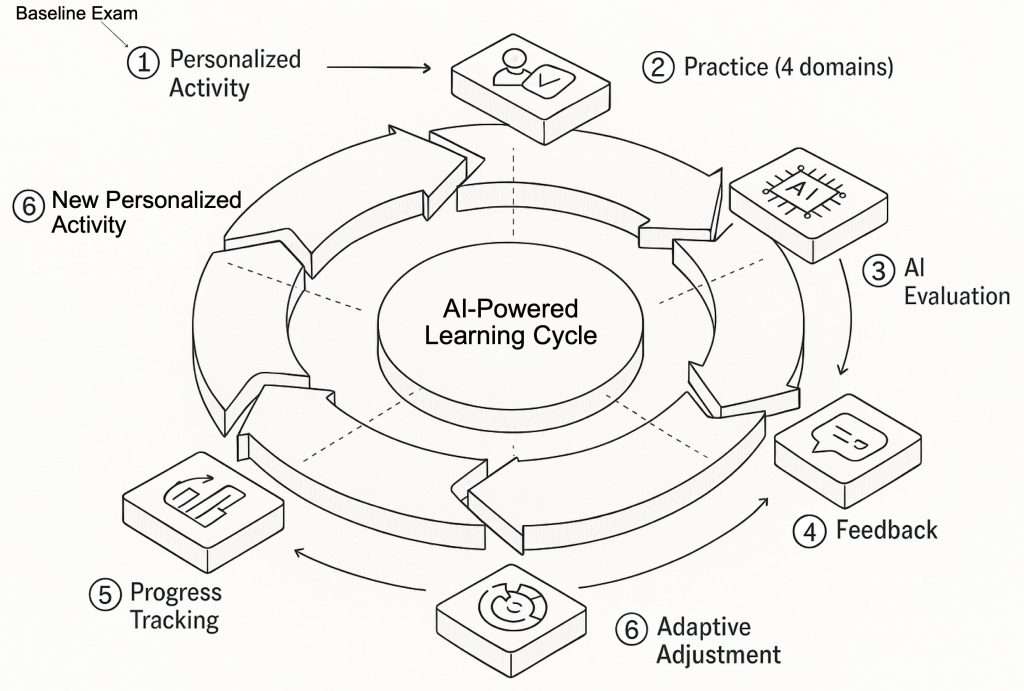
This marks a shift from traditional tutoring to a dynamic learning ecosystem that uses AI responsibly to foster language development through meaningful, personalized interaction. Whether in bilingual education or ESL instruction, Verónica helps bridge technology and pedagogy, ensuring that every AI-assisted experience remains human-centered, contextualized, and purposeful. Additionally, our system integrates databases that analyze learner performance to generate new activities aligned with each user’s current proficiency level. This adaptive design reflects the principles of Vygotsky’s theory of the Zone of Proximal Development, which emphasizes growth through guided, scaffolded interaction. We expand on this idea in our co-authored chapter, “AI-Guided Professional Development: A Vygotskian Approach for Teachers in Multilingual Classrooms,” published by IGI Global. You can read more about this work in our blog post, A New Chapter: AI-Guided Teacher Support.
A System Built for Precision
One of the key differences in our approach lies in how we manage the communication between our systems and the AI. Every activity, question, and prompt is defined using structured JSON instructions, a kind of digital format that works like a blueprint for organizing information. In simple terms, JSON (which stands for JavaScript Object Notation) helps us tell the AI exactly what to do, what kind of response we expect, and how to return it. You can think of it as a set of labeled boxes that hold very specific details, such as the topic, difficulty level, feedback type, or even the scoring criteria from a rubric. Because these boxes are always arranged in the same way, the AI knows precisely where to find information and how to respond consistently.
This structured communication allows us to design activities that include rich context (clear instructions, learning objectives, examples, and evaluation models) and ensures that the AI follows those guidelines every time. For example, when the system generates a reading comprehension activity, it doesn’t immediately show the result to students. Instead, the activity is sent through a second AI process for validation, which double-checks the questions, answers, and feedback before it’s presented to learners.
To make this possible, our system is supported by a structured data architecture that stores every student response, AI evaluation, and feedback using the same JSON framework. This information is stored in a secure database and later analyzed by AI to identify growth patterns, strengths, and areas for improvement across the four language domains. By connecting these data layers, the system can automatically generate progress reports, suggest new activities, and create personalized recommendations based on each learner’s evolving performance. In essence, it becomes an adaptive learning environment where precision, context, and personalization are built into every step.
Behind the scenes, this workflow may sound technically complex and time-consuming, but that’s where the power of modern AI and data processing truly shines. Everything happens in seconds. The student’s response, the context of the task, and even dynamic scenario information are sent back to the AI almost instantly. The system then interprets all this data through our structured JSON instructions, drawing from our database, embeddings, and custom prompts, to generate personalized, accurate, and context-aware feedback. In other words, this isn’t just ChatGPT responding to a simple prompt. It’s a carefully orchestrated process where AI reads, analyzes, and responds using multiple layers of information to ensure that every answer and every piece of feedback aligns with the learner’s goals and the instructional design behind the activity.